

Loading…
Loading…
plat-ee-SIR-ee-um el-eh-fan-TOH-tiss
Also recorded as: Platycerium elephantotis Schweinf. · Platycerium angolense Welw. All names
Recognize P. elephantotis by its broad, mostly undivided fertile fronds with one large oval spore patch near the tip. Full description
Cultivated mature Platycerium elephantotis photographed by Johnny Lee, showing the species’ exceptionally broad, nearly undivided fertile fronds.
Mature · Photo: Johnny Lee · © World Platycerium Society · All rights reservedGrows vigorously, but its large fronds lose water quickly in dry air. Keep the air humid and the growing medium moist but well drained; dry conditions can shrivel the tips of both fertile and shield fronds.
Give it bright, filtered daylight, such as near a bright window with strong sun softened by a sheer curtain. Maintain humidity with good air circulation.
A colonial epiphyte that grows high on large trees and can develop additional growing points or pups. It is also occasionally recorded on rocks. Documented habitats include dry forest, dense forest, forest edges, and open woodland, in light shade or full sun. Zambian records range from approximately 580–1,240 m (1,900–4,070 ft).
The shield fronds are broadly oblong and approximately 45 × 30 cm (18 × 12 in) in a regional flora description. Their lower portion is thick and spongy, while the upper portion is thinner and prominently veined. The heart-shaped bases overlap around the rhizome to form a substantial nest. The upper margin remains entire or becomes irregularly wavy rather than deeply divided. Young shields carry grey star-shaped hairs and become less hairy with age.
The fertile fronds are broad, rounded at the tip, entire or nearly entire, and approximately 50 × 25 cm (20 × 10 in) in a regional flora description. Their underside carries reddish-brown star-shaped hairs and one very large oval spore-bearing area below the tip, which may reach about 25 cm (10 in) across. The broad undivided form resembles an elephant’s ear rather than a branching antler.
Recognize P. elephantotis by its broad, mostly undivided fertile fronds with one large oval spore patch near the tip. P. stemaria has divided fertile fronds, P. alcicorne has repeatedly forked antler fronds, and P. ellisii has smaller rounded shields and fertile fronds that may fork once.
Original name · Latin
Alias · Latin
Alias · Latin
Alias · Latin
Translated name · English
Translated name · English
Native rangeAngola; Burundi; Cameroon; Central African Republic; Democratic Republic of the Congo; Ethiopia; Gabon; Ghana; Guinea; Ivory Coast; Kenya; Liberia; Malawi; Mozambique; Nigeria; Rwanda; Sierra Leone; South Sudan; Sudan; Tanzania; Uganda; Zambia · Tropical Africa from West Africa through Central Africa to East and south-central Africa
A cultivated group of Platycerium elephantotis photographed by Johnny Lee, showing variation among mature shield and fertile fronds.
Mature · Photo: Johnny Lee · © World Platycerium Society · All rights reservedWild Platycerium elephantotis growing on a tree near Kipushi, Democratic Republic of the Congo, showing broad fertile fronds with large brown spore patches and a substantial shield-frond nest.
Mature · November 27, 2022 · © Mathew Rees · CC BY 4.0 · Original source ↗︎Wild Platycerium elephantotis growing on a tree near Kalumbila, Zambia, showing the large persistent shield-frond nest in seasonal woodland.
Mature · June 7, 2023 · © Mahomed Desai · CC BY 4.0 · Original source ↗︎Propagated by spores and pups. Spores produce genetically new plants; pups continue the parent clone and can be separated once they have an active growing point and sufficient roots.
Sources can document who reported an account without independently confirming every detail. Each statement shows its review status and the sources that support, challenge, or give context to it.
Taxonomy
Platycerium elephantotis is an accepted naturally occurring species in Polypodiaceae and is native across tropical Africa.
Nomenclature
Georg August Schweinfurth published P. elephantotis in 1871. The older P. angolense name was not validly established as a distinct species, making P. elephantotis the correct name.
Native range
The native range extends across West, Central, East, and south-central tropical Africa. Colombia is an introduced occurrence rather than part of the native range.
Send WPS a correction, a source, or firsthand knowledge for review and possible inclusion in this record.
Platycerium elephantotis is native across tropical Africa. The Royal Botanic Gardens, Kew, a botanical research institution in the United Kingdom, accepts it in its Plants of the World Online database. German botanist and explorer Georg August Schweinfurth described it in 1871.
1871
The name combines Greek words for elephant and ear, describing the species’ exceptionally broad, largely undivided fertile fronds. The older name Platycerium angolense remains common in horticulture and appears in some scientific literature, but a nomenclatural review established P. elephantotis as the correct name.
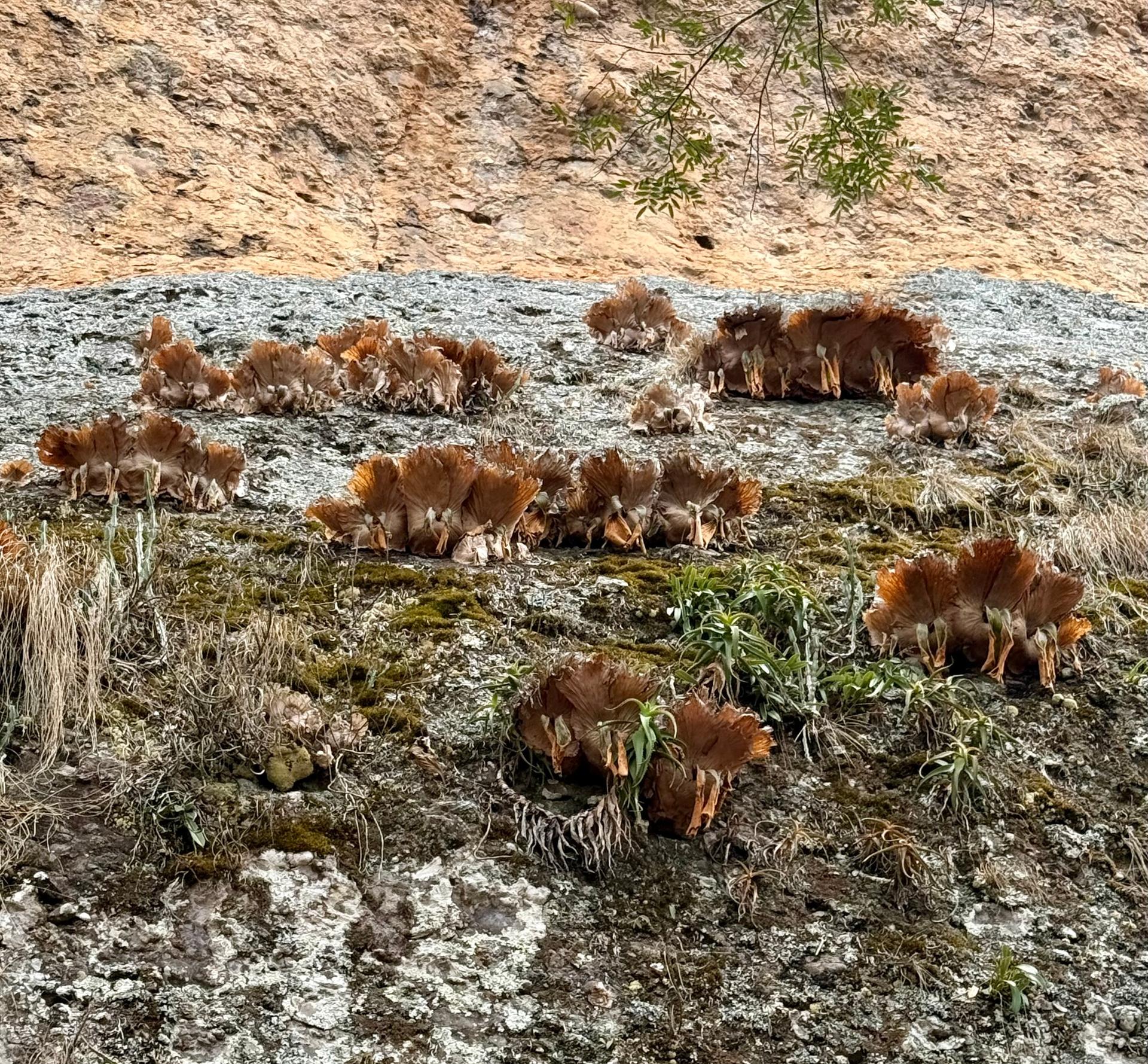
Wild colonies of Platycerium elephantotis growing directly on a rock face at the Black Stones of Pungo Andongo, Angola, documenting the species’ occasional rock-growing habit.
Mature · September 30, 2025 · © Irene (iNaturalist user aparrot1) · CC0 1.0 · Original source ↗︎Habitat
The species grows primarily as an epiphyte on large trees in forest, forest margins, and woodland, and is occasionally recorded on rocks.
Description
Shield fronds are broadly oblong, approximately 45 × 30 cm, thick and spongy below, thinner and prominently veined above, with overlapping heart-shaped bases and entire to wavy upper margins.
Description
Fertile fronds are approximately 50 × 25 cm, broadly wedge-shaped, rounded, entire or nearly entire, and bear one large oval spore patch below the tip that may reach about 25 cm across.
Identification
The broad, nearly undivided fertile frond separates mature P. elephantotis from the two-lobed P. stemaria and the repeatedly forked P. alcicorne.
Growth form
P. elephantotis can form colonies with multiple growing points rather than remaining permanently solitary.
Spores
The spores are yellowish-brown, diploid, and average approximately 59.6 × 43.4 micrometres, with small wart-like projections and granules on the surface.
Evolution
Plastid phylogenomics strongly places P. elephantotis as sister to P. stemaria; together, the African pair is sister to the South American P. andinum.
Propagation
The species can be propagated sexually from spores and clonally by separating established pups that have roots and an active growing point.
Description
The Care Book describes Platycerium elephantotis shield fronds browning relatively early, with withering progressing from the centre outward.
Kew Science — Plants of the World Online
Platycerium elephantotis Schweinf. ↗︎Date not establishedInternational Plant Names Index
Platycerium elephantotis Schweinf. ↗︎Date not establishedG.J. de Joncheere
Nomenclatural notes on Platycerium (Filices) ↗︎1974Komla Elikplim Abotsi; Kouami Kokou; Jean-Yves Dubuisson; Germinal Rouhan
A first checklist of the Pteridophytes of Togo (West Africa) ↗︎2018Mark Hyde; Bart Wursten; Petra Ballings; Meg Coates Palgrave
Platycerium elephantotis Schweinf. ↗︎Date not establishedMathew Rees
Platycerium elephantotis near Kipushi, Democratic Republic of the Congo ↗︎2022Mahomed Desai
Platycerium elephantotis near Kalumbila, Zambia ↗︎2023Irene (iNaturalist user aparrot1)
Platycerium elephantotis at the Black Stones of Pungo Andongo, Angola ↗︎2025杉山拓巳
全年度 鹿角蕨栽培基礎書Date not establishedE. Hennipman; M.C. Roos
A monograph of the fern genus Platycerium (Polypodiaceae) ↗︎1982Riccardo Ciarle; Katrijn de Bock; Kevin C. Burns
Evolutionary origins and life-history correlates of coloniality in the epiphytic fern genus Platycerium (Polypodiaceae)Dan-Ni Ma et al.
Spore Morphology of Platycerium (Polypodiaceae) and Its Implications ↗︎2026Z. Chen et al.
“Out of Africa” origin of the pantropical staghorn fern genus Platycerium supported by plastid phylogenomics and biogeographical analysis ↗︎Date not establishedTalk with other growers about this plant. Ask a question, share a photo, or tell us how you grow it. Member posts and photos are separate from the reviewed registry record.
No sales or unsolicited promotion. Help keep conversations respectful and relevant.No conversations yet.
No growers have showcased this plant yet.
Growing this plant? Add it to your collection and showcase it here.